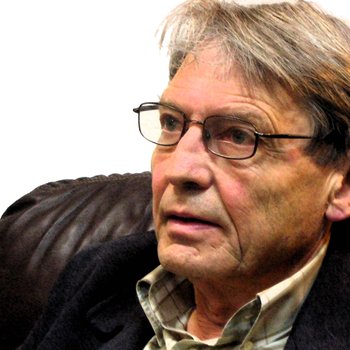
Jean-Claude Risset (March 13, 1938 – November 21, 2016) was a distinguished French composer known for his extensive body of work in orchestral, chamber, vocal, piano, and electroacoustic music, which gained international recognition. He was also a prolific writer.
Risset began his musical education in composition under notable figures such as Suzanne Demarquez and André Jolivet, while also studying piano with Huguette Goullon and Robert Trimaille. His academic pursuits extended beyond music, as he studied mathematics and physics at the École Normale Supérieure de Paris starting in 1957, culminating in a Doctorat ès Sciences in 1967. He received honorary doctorates from the University of Edinburgh in 1994 and the Universidad de Córdoba in 2000.
Throughout his career, Risset garnered numerous accolades, including the UFAM Prix pour Piano in 1963, the Prix du Groupement des Acousticiens de Langue française in 1967, and a prize in the Dartmouth electronic music competition in 1970 for his work "Mutations." His contributions to the field were recognized with Bronze, Silver, and Gold medals from the Centre National de la Recherche Scientifique in Marseille in 1972, 1987, and 1999, respectively. He also achieved First Prize, Euphonie d'Or, and the Prix Magisterium in the Concours International de Musique Électroacoustique de Bourges in 1980, 1982, and 1998. Additional honors include the Grand Prix SACEM de la promotion de la musique symphonique in 1981 and the Golden NICA from Ars Electronica in Graz in 1987. Later recognitions included the Grand Prix National de la Musique in 1990, the Grand Prix Musica Nova in Prague in 1995, the Ars Nova Prize in Prague in 1996, and the EAR Prize in Budapest in 1997. In recognition of his artistic contributions, he was named an Officier de l'Ordre des Arts et des Lettres in 1986 and a Chevalier de la Légion d'Honneur in 1989.
Risset's works have been performed by a diverse array of soloists, including flautists Robert Aitken (2), Pierre-Yves Artaud, Roberto Fabbriciani, Gérard Garcin, and Katrin Zenz; pianists Ancusa Aprodu, Christian Ivaldi, Martine Joste, Michel Oudar, Jean-Claude Pennetier, Georges Pludermacher, Jacques Raynaut, and Dimitri Vassilakis; and bass Jacques Bona. His compositions were also showcased by clarinettists Serge Conte, Michel Lethiec, and Michel Portal; organist Marie-Hélène Giespieler; sopranos Linda Hirst, Janice Jackson, Irène Jarsky, Rovena Koreta, Jane Manning, and Maria Tegzes; saxophonist Daniel Kientzy; violinist Mari Kimura; Celtic harpist Denise Mégevand; and percussionist Thierry Miroglio.
In addition to composition, Risset held various significant positions in the music community. He collaborated with Max Mathews at Bell Telephone Laboratories, Inc. in 1965 and from 1967 to 1969, focusing on brass synthesis and later on pitch paradoxes, sonic development processes, and the synthesis of new timbres. His tenure at the Centre National de la Recherche Scientifique in Marseille spanned from 1969 to 1972, where he became Directeur de recherche at the Laboratoire de Mécanique et d'Acoustique in 1985 and was designated Directeur de recherche émérite in 1999. He established computer sound systems at the Faculté d'Orsay and the Université de Paris during 1970-1971 and served as chair of the computer department at IRCAM from 1975 to 1979. Risset also held the position of composer-in-residence at the Media Laboratory at MIT in 1987 and 1989.
As an author, he contributed extensively to the discourse on computer and electronic music through numerous articles in various journals and magazines, as well as the book "An Introductory Catalog of Computer Synthesized Sounds" (1969, with a second edition in 1995, published by Wergo).
Risset taught at the Université d'Aix-Marseille from 1972 to 1975 and again from 1979 to 1985, where he was instrumental in establishing the university's computer sound system in 1974. His expertise also took him to lecturing engagements in countries such as Argentina, Australia, Finland, France, Japan, and the USA.