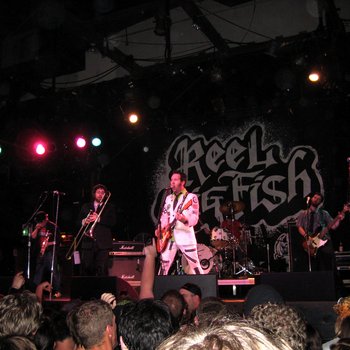
Reel Big Fish is a ska-punk band hailing from Huntington Beach, California, that emerged as part of the wave of Southern California ska-punk groups gaining mainstream traction in the wake of No Doubt and Sublime's mid-'90s success. Known for their energetic live performances, playful humor, ironic covers of new wave hits, and a unique fusion of ska and punk, the band initially developed a dedicated underground following. Their breakthrough came in the summer of 1997 with the single "Sell Out," which became a staple on modern rock radio and MTV. Their appearance as the halftime band in the film "Baseketball" further boosted their visibility and popularity.
Reel Big Fish's journey began with their self-released debut album, "Everything Sucks," in 1995, which quickly became an underground favorite among ska-punk and college music enthusiasts. This success paved the way for a deal with indie label Mojo Records. Co-produced by Mojo's president Jay Rifkin and former Oingo Boingo bassist John Avila, their first album for the label, "Turn the Radio Off," was released in August 1996. The band supported the album with extensive touring, which helped them grow their fan base. By spring 1997, "Sell Out" garnered significant airplay from influential modern rock stations, leading to increased support from MTV, and the album subsequently reached the Top 100.
In 1998, the band released "Take on Me," featured on the "Baseketball" soundtrack, which again saw them regularly played on rock radio and MTV. The following year, they released "Why Do They Rock So Hard," with John Avila returning as producer. Although not as commercially successful, many fans consider it one of the band's best works, highlighted by the single "The Setup (You Need This)."
In the fall of 2001, after Mojo Records was acquired by Jive Records' parent company, Reel Big Fish signed with Jive. Their first release under the new label, "Cheer Up!" debuted in mid-2002 and achieved considerable success in Europe, particularly with the single "Where Have You Been," which received heavy rotation on music video channels. That year, they also recorded "Snap, Krackle, Pop-punk," a song for Rice Krispies commercials, and covered Toots and the Maytals' "Monkey Man" for the Nickelodeon film "The Wild Thornberrys," which also enjoyed considerable radio play and video exposure.
The album "We're Not Happy 'Til You're Not Happy" was released in April 2005, and the band continued their touring schedule throughout the year. In January 2006, they parted ways with Jive, having wished to leave since the "Cheer Up!" release. In August of that year, they self-released a double-disc live album with a DVD titled "Our Live Album Is Better Than Your Live Album," which Barrett described as capturing the energy and humor of their live performances, earning it the nickname "the Reel Big Fish Stand-up comedy album."
The band returned with new material in February 2007, releasing the EP "Duet All Night Long" in collaboration with Zolof the Rock & Roll Destroyer. Later that year, they launched "Monkeys for Nothin' and the Chimps for Free," their first full-length studio album since leaving Jive. In 2009, they released "Fame, Fortune and Fornication," featuring covers of songs by Poison, the Eagles, and Tom Petty.
2010 saw the release of "A Best of Us for the Rest of Us," a compilation including a disc of re-recorded hits and classic fan favorites, along with a bonus disc of 14 acoustic or "SKAcoustic" versions. Their seventh studio album, "Candy Coated Fury," was released in 2012 under Rock Ridge Music, marked by a return to the upbeat ska sound and humor of their earlier work.
In 2014, the band released their first Christmas album, "Happy Skalidays," a six-song digital-only collection featuring four classic holiday songs and two original tracks. Their eighth studio album, "Life Sucks...Let's Dance," was released in late 2018 through Rock Ridge Music, showcasing a refreshed outlook and creative spirit, aided by the positive energy from their new studio environment. Barrett noted that while the album contains some lighthearted love songs, the band still maintained their signature humor and sarcasm. The lead single, "You Can't Have All of Me," exemplifies their catchy, danceable style, affirming that they remain committed to their distinctive sound.