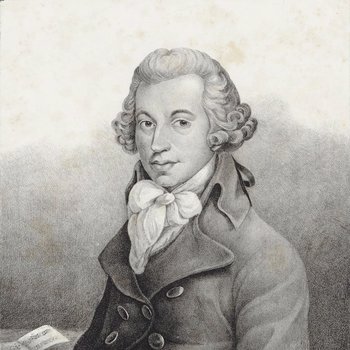
Ignace Joseph Pleyel (18 June 1757, Ruppersthal, Lower Austria – 14 November 1831, Paris, France) was an influential Austrian-born French composer, piano manufacturer, music publisher, and founder of the esteemed company Pleyel et Cie.
Pleyel's early life was spent in Austria, where he likely received instruction from Johann Baptist Vanhal. In 1772, he became a student of Joseph Haydn in Eisenstadt, forming a close friendship with his mentor and becoming one of Haydn's favored pupils. He made his compositional debut in 1782 with Opus 1, a collection of six string quartets dedicated to Count Ladislaus Erdődy (1746–1786), who supported his education and was admired by Mozart, as noted in an April 1784 letter from Mozart to his father, Leopold. Pleyel soon traveled to Italy, where he composed his first opera, Ifigenia in Aulide (1785), along with several works commissioned by Ferdinand I, King of Two Sicilies (1751–1825).
In 1783, Pleyel moved to France, taking on the role of organist and assistant "maître de chapelle" (kapellmeister) under Franz Xaver Richter (1709–1789) at the prestigious Cathédrale de Strasbourg. This position proved advantageous, as it afforded him access to a full orchestra, choir, and a substantial concert budget. Throughout the next decade, he produced a significant body of work, regularly premiering new compositions at the Cathedral, including liturgical music and numerous "symphonies concertantes." Following Richter's death in 1789, Pleyel became the full kapellmeister, but the onset of the French Revolution curtailed church performances and concerts. He then traveled to England at the invitation of Wilhelm Cramer, conducting the "Professional Concerts" subscription series at Hanover Square Rooms in London. Pleyel, like his mentor Haydn, found success on British tours and returned to Strasbourg, where he purchased the Château d'Ittenwiller in the Bas-Rhin region.
In 1793, amid the escalating political turmoil in France and the beginning of the "Reign of Terror," Pleyel was summoned by the Committee of Public Safety, which labeled him a "Royalist sympathizer." He narrowly avoided imprisonment or worse by publicly renouncing his supposed affiliations, offering to demonstrate his loyalty through the composition of hymns and instrumental works celebrating the new First Republic. Two years later, Pleyel relocated to Paris and founded the Maison Pleyel publishing house in 1797. This venture flourished, culminating in a complete edition of Haydn's string quartets in 1801 and the publication of nearly 4,000 works over the next forty years, featuring composers such as Ludwig van Beethoven, Wolfgang Amadeus Mozart, Luigi Boccherini, Muzio Clementi, Johann Baptist Cramer, Johann Nepomuk Hummel, and George Onslow.
In 1807, at the age of fifty, Pleyel transitioned into piano manufacturing by establishing the firm Pleyel et Cie. His business prospered, bolstered by technological innovations, including the introduction of metal frames for grand pianos. In 1815, his son Camille Pleyel (1788–1855) joined the firm as a partner. Together, they successfully launched a popular pianino model — a compact, vertically-strung upright piano inspired by the design of British maker Robert Wornum (1780–1852). After Ignace retired in 1824, Camille took over the family business.
Pleyel was a prolific composer, with a catalog that included 42 symphonies, over 85 quartets, and several operas before he concentrated exclusively on his piano enterprise. Despite achieving significant acclaim during his lifetime, Pleyel's works faded into relative obscurity in the years that followed, akin to the fates of composers like Luigi Cherubini, Giacomo Meyerbeer, and Sigismond Thalberg. Interest in his music began to resurge in the 1950s, and in 2010, the German label Ars Produktion launched a comprehensive recording series of Pleyel's works, featuring over 15 albums by the Ignaz Pleyel Quintett, Ignaz Pleyel Quartett, Ignaz Joseph Pleyel Orchester, and various established European chamber ensembles. The enduring legacy of Ignaz Pleyel and his piano company is evident in the numerous musical groups named in his honor, including Quatuor Pleyel, Pleyel Quartett Köln, The Pleyel Ensemble, and Duo Pleyel.