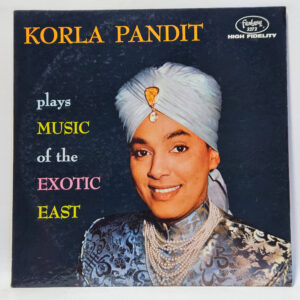
Korla Pandit, born John Roland Redd on 16 September 1921 in St. Louis, Missouri, passed away on 2 October 1998 in Petaluma, California. He was an influential American pianist, organist, and composer, recognized as a key figure in the Exotica genre and a pioneering performer in television music. In the late 1940s, Redd adopted the persona of the fictional French-Indian character Korla Pandit, maintaining this identity consistently throughout his life, both on stage and in his personal life, even concealing his true identity from his children. A detailed exposé on Korla Pandit was published by Los Angeles Magazine in 2001, three years after Redd’s death.
Redd was the seventh of eight children in a family led by an African-American Baptist pastor. His mother had a mixed heritage of Anglo and African descent, which contributed to his lighter skin and straight hair. A child prodigy, Redd began playing the piano at the age of three and could accurately reproduce any song after hearing it just once. In the early 1940s, he moved from the Midwest to California to pursue his musical ambitions. Facing discrimination as a black musician, Redd adopted the alias Juan Rolando, allowing him to pass as Mexican and gain entry into the Musicians' Union, where African-Americans were often barred. In 1944, he married Beryl June DeBeeson, a retired dancer and Disney artist, in Tijuana, Mexico, as interracial marriages were illegal in California at the time.
With Beryl's assistance, Redd crafted the Korla Pandit persona, which included elaborate makeup and exotic attire. According to a fabricated backstory, Korla Pandit was said to have been born in New Delhi to a French opera singer and an Indian government clerk of Brahmin descent. Supposedly raised in an affluent household and educated in music in the UK, he immigrated to the United States at the age of twelve and graduated from the University of Chicago. By 1948, Korla Pandit was regularly performing in Hollywood and had composed music for the popular radio series Chandu the Magician, utilizing Novachord and Hammond CV electric organs to create atmospheric sound effects.
Redd's encounter with television producer Klaus Landsberg led to his first television show after he agreed to compose music for Time for Beany, Bob Clampett's well-known puppet show. In February 1949, his program Korla Pandit's Adventures In Music debuted on Los Angeles KTLA, marking it as the first all-music program in the history of U.S. television. To enhance the mystique of his character, Pandit never spoke during his broadcasts. He quickly gained fame, releasing numerous LP albums primarily through Fantasy Records and mingling with Hollywood celebrities such as Bob Hope, Errol Flynn, and Sabu Dastagir. He also appeared in George Stevens' 1952 film Something to Live For.
Fully committed to his Korla Pandit persona, Redd never broke character, even off-camera. He developed a friendship with Paramahansa Yogananda, a notable Indian yogi and spiritual leader, and performed at Yogananda's funeral in 1952. In 1956, Korla Pandit relocated to San Francisco and began a new program on KGO-TV. Responding to the Beat Generation's interest in spirituality and alternatives to materialism, he started to incorporate dialogue into his shows, blending Zen, mysticism, and other "New Age" themes. In 1967, he moved to Canada to protect his two sons from the Vietnam War draft, settling in Vancouver, British Columbia. As his television popularity waned in the 1970s, he shifted to performing at private events and ceremonies.
In the 1990s, amidst a revival of Exotica and the Tiki-lounge movement, Korla Pandit saw a brief resurgence in his career. He recorded as a guest on the debut self-titled album by The Muffs in 1993 and made a cameo appearance in Tim Burton's cult biopic Ed Wood. One of his final performances was a sold-out show at Bimbo's 365 Club. In June 2001, R.J. Smith’s exposé in Los Angeles Magazine revealed Redd's true identity and his lifelong dedication to the character of the "mysterious Indian." The article included insights from Redd’s wife and sons, who appeared unaware or in denial of the revealed biographical details, having had limited contact with their father’s extended family throughout his life.