Nicholas Alexandre Voboam II, also recognized as "Alexandre Nicolas" and Alexandre Voboam Le Jeune (circa 1634/46 — circa 1692 or June 1704, active 1673–92, Paris), was a notable French luthier renowned for his guitar craftsmanship. He was the son of René Voboam (circa 1606—circa 1671) and the brother of Jean Voboam (circa 1633/46—circa 1692). The relationships within this artistic dynasty were not thoroughly examined until 2005, when French musicologist Florence Gétreau (born 1951) reconstructed a tentative family tree of the Voboams and enhanced the catalog of their known instruments in her article for the Journal of the American Musical Instrument Society.
Gétreau's research significantly clarified the identities of two individuals named Alexandre within the Voboam lineage: Alexandre Voboame l'aîné (dates unknown—circa 1679), referred to as the "Elder," likely a sibling of René, and Alexandre [i]Le Jeune[/i], or "Junior," who is confirmed as the son of René Voboam through a marriage certificate dated January 1671, which records the union of the "master instrument maker" Alexandre and Anne Bourdet. Interestingly, Alexandre was initially illiterate and unable to sign his own name. His first known autograph appeared in a workshop inventory from 1681, recorded as "[i]A. VoBoan[/i]," while by 1682, as noted in a revised marriage contract, he had adopted the signature "[i]A. voboam[/i]." His death is estimated to have occurred before June 1704, the earliest documented reference to Anne Bourdet as the "widow of Nicolas Vauboam" in Parisian records.
Another key aspect of Gétreau's analysis concerns the luthier's plaques. She argued that three guitars dated 1652, signed "[i]Alexandre | voboam · a | paris[/i]," were likely crafted by an older family member, as René Voboam's son would have been only around eighteen at that time, while these instruments exhibit a high level of craftsmanship. In contrast, four guitars made between 1673 and 1679 bear the inscription "[i]Alexandre Voboam le Jeune[/i]," clearly indicating work by the younger luthier who aimed to distinguish himself from the "Senior" namesake. Following 1680, subsequent instruments were simply signed "[i]Alexandre Voboam[/i]," suggesting that Alexandre Voboam I had likely passed away, making the "Jeune" suffix unnecessary.
Known guitars
- Signed on the ivory plaques: [i]Alexandre | Voboame | Le Jeune[/i] or [i]Lejeune | 16[/i]**
- 1673 ◇ Private collection of Marquis de Lusignan (1753—1832), signed "[i]Alexandre Vogeant Lejeune[/i]" (notable name variation); current status unknown since 1793, presumed lost
- 1675 ◇ Collection of Harvey Hope, Sanderstead, UK
- 1676 ◇ Musée De La Musique, Paris
- 1679 ◇ Collection of U.S. luthier and violin dealer Jacques Français (1923—2004), New York
- Signed without the "Junior" suffix: [i]Alexandre | Voboam | 16[/i]**
- 1680 ◇ Museum Of Fine Arts Boston, Massachusetts, USA
- 1682 ◇ Musée De Cluny, Paris, on deposit at Musée de la Musique
- 1688 ◇ Formerly in the private collection of Ernest Loup, last sold at his estate auction in May 1888; current whereabouts unknown
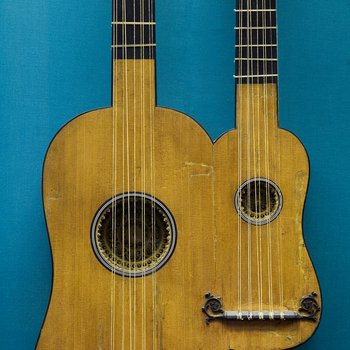
- 1690 ◇ Double Guitar at Kunsthistorisches Museum Wien, Austria. This exceedingly rare five-course guitar features a smaller deck mounted at the upper right, likely designed for a continuo player, allowing quick shifts between E' and A' pitches. A January 1997 technical report by Stephen Barber (2) and Sandi Harris noted the larger deck's sides are constructed from figured quarter-sawn walnut, with a cypress back embellished with four sets of inlaid ebony stripes. Both necks are made from maple and veneered with ebony, indicating Voboam's typical method of creating a one-piece "neck-heel-block."
- 1692 ◇ Musée De La Musique, Paris
Name variations: Voboame, Vaubouin, Vauban, Vauboyet, Vobuan, Roboam.