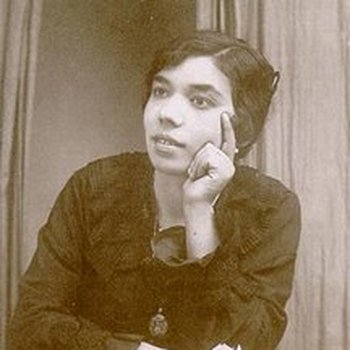
Pastora Pavón Cruz, affectionately known as La Niña de los Peines, was born in Seville, Spain, on February 10, 1890, and passed away on November 26, 1969. She is widely regarded as the most significant female flamenco singer of the 20th century. Pastora was the sister of singers Arturo Pavón and another sibling, and the aunt of the first flamenco pianist, known as Arturo Pavón. Alongside her brother Tomás and singer Manuel Torre, she served as an influential figure for the next generation of flamenco artists, including Antonio Mairena, Pepe de la Matrona, and Fosforito, who played a key role in reviving traditional flamenco styles during the 1950s to 1970s.
Raised in the renowned Alameda de Hércules neighborhood of Seville, Pastora began her public singing career at the tender age of eight during the "Feria de Sevilla." Her time at Café de la Marina, a café cantante in Madrid, marked the beginning of her rise to fame, where she earned the nickname La Niña de los Peines, derived from a stanza she sang in the tangos style: "Peinate tú con mis peines / Mis peines son de canela." Despite her growing popularity, she never learned to read or write, only signing her name as an adult.
Facing financial hardship, Pastora started performing professionally at the Taberna de Ceferino in Seville, later moving to Madrid and Bilbao. In Bilbao, her youth prevented her from singing publicly, leading her to pose as a model for painter Ignacio Zuloaga. Upon returning to Andalusia, she performed at various cafés cantante in Jerez, Seville, Málaga, and other locations. In 1910, she made her first recordings, and by 1920, the Teatro Romea was paying her the highest fee it had ever offered to an artist. This success enabled her to embark on extensive tours across Spain.
In 1922, Pastora participated in the Concurso de Cante Jondo in Granada, a prestigious music festival organized by Manuel de Falla and Federico García Lorca to revitalize flamenco. She performed alongside notable artists such as Antonio Chacón, Manuel Torre, Juana la Macarrona, and Ramón Montoya, and was appointed as one of the judges for the non-professional contestants.
Throughout her illustrious career, Pastora shared the stage with many renowned flamenco singers of the Golden Age, including Antonio Chacón, Manuel Torre, Francisco Lema (Fosforito El Viejo), El Canario, La Trini, and Frijones. In 1922, she met Federico García Lorca, who later praised her voice in a 1933 lecture, stating: "This woman's voice is exceptional. It breaks the moulds of all singing schools... owing to the special miracle of this style and the passion with which she sings third tones and quarter tones, impossible to record on the staff." (Quoted by Antonio Reina in Museo Virtual de la Niña de los Peines)
In 1931, she married fellow flamenco singer Pepe Pinto, who was 13 years her junior. After a hiatus during the Spanish Civil War, Pastora returned to the stage, performing in various flamenco shows with artists like Concha Piquer. She took another break before re-emerging with the acclaimed show España y su Cantaora, which she toured with her husband for several months. Eventually, she retired again from performing.
In 1961, Pastora was honored in Córdoba with a tribute featuring several prominent flamenco artists, including Antonio Mairena, Juan Talega, Manuel Morao, and Fernando Terremoto. A monument was erected in her honor in Alameda de Hércules in 1968. In the final three years of her life, she withdrew from public life due to senile dementia. Pastora passed away in 1969, just over a month after her husband. That same year, Antonio Mairena released an album titled Honores a la Niña de los Peines as a tribute to her legacy. In 1996, during the IX Bienal de Flamenco, the Andalusian government recognized her voice as Bien de Interés Cultural (Asset of Cultural Interest).