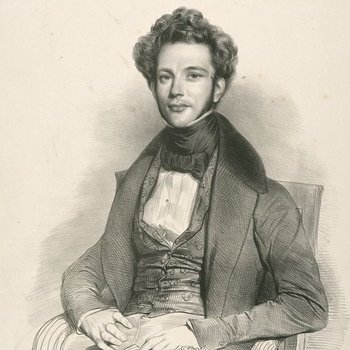
Henri Herz (6 January 1803 {2 January 1806}, Vienna, Austria – 5 January 1888, Paris, France) was a notable French piano manufacturer, virtuoso pianist, composer, and educator. He is primarily recognized for his invention of the "Herz spring" ([i]Repetierfeder[/i]), a simplified iteration of Sébastien Érard's double repetition mechanism, which laid the groundwork for the modern mechanisms found in all grand pianos today. Between 1842 and 1874, Herz served as a professor at the Paris Conservatory.
Born into a Jewish family in Vienna, Herz received his initial music training from his father. He later moved to Koblenz, Germany, to study under organist Daniel Hünten (1760–1823), the father of Franz Hünten. In 1816, he arrived in France and enrolled at the Conservatoire de Paris, where he studied composition with Anton Reicha and was influenced as a pianist by Ignaz Moscheles. While the specifics of his interest in instrument-making remain unclear, it is evident that Herz's designs for fortepianos were influenced by the lineage of prominent makers such as Gottfried Silbermann (1683–1753), who taught notable figures like Johannes Zumpe (1726–1790) and Americus Backers (ca. 1740 – post-1778). These makers, part of the "Twelve Apostles" group, fled Germany during the Seven Years' War and significantly influenced the next generation of piano makers, including Sébastien Érard and Herz himself.
In 1839, Herz established an independent piano workshop with his elder brother, Jacques Simon Herz (1794–1880), a pianist and graduate of the Paris Conservatory. Prior to this, Herz was a partner in the "Henri Klepfer et Cie" piano factory from 1825, but their partnership was marked by tension. As an innovative engineer, Herz continually sought advancements in the fortepiano mechanism. He notably transitioned from a single-layered hammer to a more complex design featuring two layers of leather, fabric, and rabbit fur inside, complemented by nine layers of wool of varying hardness on the exterior. Although this change slightly reduced overall loudness, it significantly enhanced dynamics and tonal brightness. Over the next fifteen years, Herz's workshop gained recognition, positioning [i]Herz[/i] among the top three French piano manufacturers, alongside [i]Érard[/i] and [i]Pleyel[/i]. All three brands received the prestigious "Médaille d'honneur" at the 1855 Paris World's Fair. Between 1843 and 1866, Herz secured numerous patents for inventions related to piano construction and manufacturing.
The Herz brothers were also responsible for the construction of a new building on rue de la Victoire in 1838, which included a 660-seat concert hall known as [i]Salle des Concerts Herz[/i] and the "Ecole Spéciale de Piano de Paris," which they co-founded. This practice was common among European piano manufacturers, with other notable examples being and Bechstein Concert Hall in London. The Salle des Herz became a prominent music venue, operational until 1874, and hosted significant premieres by composers such as Berlioz and Offenbach. Despite his entrepreneurial commitments, Herz maintained an active performance career, touring extensively across Europe and internationally, including solo recitals in Russia, Mexico, and South America. From 1846 to 1850, he toured the United States, performing concerts from coast to coast. As a prolific composer, Herz produced eight piano concertos and over 200 smaller works, including rondos, nocturnes, waltzes, fantasias, and variations. Following his retirement, his piano company seemingly ceased operations, as he did not have male heirs or apprentices to continue the business.
In addition to his teaching role at the Paris Conservatory, where he taught for over thirty years and mentored notable students like Maria Roger-Miclos, Herz patented a curious mechanical training device in 1835 called [i][b]Dactylion[/b][/i]. This device, mounted atop the piano keyboard, featured ten adjustable weighted rings that students placed on their fingers to build strength. Although its design may have seemed more suited to a torture chamber than a piano studio, the Dactylion gained popularity and was followed by other similar inventions, such as [i]Chirogymnast[/i] in 1840 and the [i]Ochydactyl[/i] in 1922. Fortunately, piano pedagogy eventually evolved beyond such "brute-force" methods, shifting focus towards proper finger placement and overall coordination.