Giovanni Battista Guadagnini (June 23, 1711 – September 18, 1786) was an esteemed Italian luthier, recognized as one of the foremost makers of violins and cellos in history, following in the footsteps of masters such as Antonio Stradivari (1644–1737) and Giuseppe "del Gesù" Guarneri (1698–1744). His career spanned 44 years and took him across four distinct Italian regions, each of which significantly influenced his work.
The details of Guadagnini's early life remain somewhat obscure. It is believed that he was raised in the province of Piacenza and was either self-taught or apprenticed to an unidentified master. Some of his early labels include the phrase filius Laurentij (meaning "son of Laurentio"), a common designation among family-trained luthiers. However, there is no conclusive evidence that his father, Lorenzo Guadagnini (1685–circa 1746), who worked as an innkeeper, had any involvement in luthiery. Guadagnini began crafting violins around 1740 in Piacenza and created his first violoncellos in 1743–44, possibly inspired by his close friend, cellist and composer Carlo Ferrari (1714–1790).
In 1749, Guadagnini relocated to Milan, where he had access to a rich supply of high-quality wood and produced over 100 exceptional violins in the following nine years, characterized by their striking deep-red varnish. During this time, he established a strong reputation, with his instruments noted for their reliability, ergonomic design, and outstanding tonal qualities.
In 1758, Guadagnini moved to Parma, following Carlo Ferrari, who had been appointed by the Duchy of Parma. Interestingly, at least a dozen violins from this period bear the label Joannes Baptista Guadagnini Cremonenſis, suggesting a claim to Cremona as his birthplace—potentially an attempt to enhance his brand by associating with a more prestigious heritage. Shortly thereafter, he was commissioned by the Duchy of Parma, incorporating the monogram C.S.R. (for "His Serene Royal Highness") into his labels. Despite working with less desirable wild oppio maple wood in Parma, Guadagnini continued to excel. The sudden death of Duke Philip in 1765, however, led to a significant reduction in his court stipend, along with a decline in his clientele as the mandatory mourning period affected the local music scene. By the late 1760s, Guadagnini faced financial difficulties, with researchers noting the absence of his eldest son, Gaetano Francesco Lorenzo (1750–1817), from the 1771 church census in Parma, suggesting that Gaetano may have been traveling to seek new opportunities. In the summer of 1771, after obtaining permission from the Duchy along with a severance package, the Guadagnini family departed from Parma.
Giovanni's next destination was Turin, a strategic choice given its vibrant musical environment and the royal seat of King Charles Emmanuel III of Sardinia, which was in need of skilled luthiers. However, following the king's death in 1773, an extended mourning period again dampened the demand for musical instruments. In 1774, Guadagnini formed a friendship with young count Ignazio Alessandro Cozio di Salabue (1755–1840), who had a deep interest in luthiery and had recently acquired the Stradivari workshop in Cremona, including tools, molds, and technical drawings. Cozio recognized a unique opportunity for collaboration and offered Guadagnini a contract, providing him with high-quality aged wood and access to the legendary Stradivari toolkit and archives. Between 1774 and 1779, Guadagnini created over 50 instruments for Cozio.
Despite this promising partnership, their relationship soured, leading to the dissolution of their collaboration. Correspondence from this period reveals that Cozio sought to have Guadagnini produce perfect replicas of Stradivari’s work, while Guadagnini preferred to maintain his original designs and insisted on full credit for his creations. Under pressure from Cozio, Guadagnini later adopted the label Joannes Baptista Guadagnini Cremonenſis fecit Taurini alumnus Antonii Stradivari, implying a shared authorship. This claim gained traction in the late 19th century when biographers, eager to fill gaps in historical narratives, incorrectly associated Guadagnini with a fictitious lineage as a pupil of Stradivari.
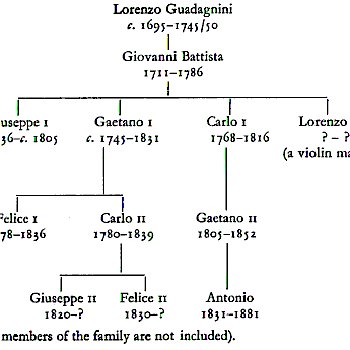
The Guadagnini family legacy continued through three of Giovanni's sons, who also became notable luthiers, excelling in the creation of guitars and mandolins: Gaetano Francesco Lorenzo I (1750–1817), Giuseppe Antonio Santo I (1753–1805), and Carlo Pietro Antonio (1768–1816). The family's lineage in luthiery persisted for over 250 years, concluding with Paolo Guadagnini (1908–1942), a triple-great-grandson.
Posthumous Recognition
In the years following his death, Guadagnini's instruments, particularly those crafted in Milan and Turin, have appreciated significantly in both monetary value and artistic esteem. Typically, Guadagnini violins and cellos are traded in the range of $180,000 to $320,000, with auction records showing sales of $2,106,000 for a violin and $2,460,000 for a cello in 2018.
Among the notable performers of Guadagnini instruments are:
𝄞 Arthur Grumiaux, 1752 violin
𝄞 Henri Vieuxtemps and Carl Flesch, circa 1750 violin
𝄞 Henri Temianka, 1752 'after P.Guarnerius' model
𝄞 Henryk Wieniawski, 1750 violin
𝄞 Jascha Heifetz, 1741 'fecit Piacenza' violin
𝄞 Joseph Joachim, 1767 Parma
𝄞 New York Philharmonic’s principal, 1754 'fecit Milan' cello
𝄞 Gilberto Munguia, 1748
𝄞 Sol Gabetta, 1759
Guadagnini's legacy, marked by innovation and craftsmanship, continues to resonate within the world of classical music.