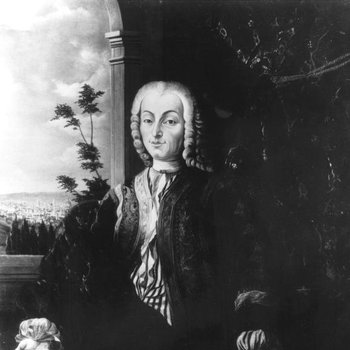
Bartolomeo Cristofori (4 May 1655, Padua — 27 January 1731, Florence) was an Italian inventor and craftsman known for his work in creating keyboard stringed instruments, including harpsichords, clavichords, spinets, and early fortepianos. For much of the 18th century, Cristofori's contributions were largely overlooked, with many attributing advancements in the fortepiano's mechanical action to the German maker Gottfried Silbermann (1683—1753). However, subsequent research by musicologists and art historians has recognized Cristofori as a pioneering figure in the invention of the modern piano. Name variations: Bartholomæus de Christophoris, Cristofali, Christofori, Cristofani, "il Burtulo."
Details about Cristofori's early life in Padua are sparse, with only his birthdate confirmed through baptismal records. A popular narrative among 19th-century scholars suggested that he studied luthiery in Cremona under the esteemed Niccolò Amati (1596—1684). This claim stemmed from a 1680 census in the Cremonese parish archives, which noted a "Christofaro Bartolomei, 13y.o.," residing with the Amati family. However, the earliest author to reference this coincidence, Italian musicologist Giovanni De Piccolellis (1839—1928), pointed out in his 1855 work Liutai Antichi e Moderni that the timeline did not align, as Cristofori, born in 1655, could not have been thirteen at that time. Despite this inconsistency, many subsequent authors perpetuated the connection between Cristofori and the renowned luthier, often ignoring the evident chronological discrepancies.
In 1688, Cristofori moved to Florence at the invitation of the Grand Prince of Tuscany, Ferdinando De' Medici (1663—1713), a significant patron of the arts. In Florence, he took on the role of a full-time stipendiary at the Medici court, where he received housing and covered expenses. This advantageous position likely accounts for Cristofori not being a member of the Università di Por San Piero e dei Fabbricanti guild, which included most other Florentine instrument makers. His responsibilities included tuning and maintaining harpsichords and other instruments, collaborating with over 100 artisans at the Galleria dei Lavori. Additionally, Cristofori restored numerous antique harpsichords from the Medici's collection, including those by Girolamo Zenti and other makers. By around 1690, he established a private workshop on Canto degli Alberti in the parish of San Remigio, where he worked alongside Giovanni Ferrini (1698—1758) and other assistants. In this workshop, he created various innovative instruments, such as an "oval spinet" (a virginal with longer strings in the middle), a "spinnetone da orchestra" (a multi-choired spinet designed for theatrical use), and a "cembalo rito in piedi," an upright harpsichord. Cristofori's hammer action, which would later contribute to the development of the fortepiano, is first documented in 1700 when a Medici inventory listed one of his new instruments as Arpicimbalo di Bartolomeo Cristofori di nuova inventione, che fa' il piano, e il forte ("Newly invented harpsichord by Bartolomeo Cristofori, which makes the piano and the forte").
There remains some debate regarding Cristofori's involvement in luthiery, with a few existing instruments suggesting he may have been engaged in violin-making or at least collaborated with other luthiers, possibly including one of his assistants. German expert Florian Leonhard (b. 1963) identified a potential collaborator in his 2022 book The Makers of Tuscany—Rocco Domenico Doni (fl. ca. 1690—1725), a luthier who worked at the Medici court alongside Cristofori. However, definitive evidence to clarify the nature of their collaboration has yet to surface.
Notable instruments attributed to Cristofori include:
- 1717 Contrabass at the Metropolitan Museum of Art in New York, USA (Inventory number: 1980.112). It is not on display and is labeled as "Former Attribution" due to a non-authentic label stating: Io Bartolomeo Cristofari | Fecit in Firenze | .. . 17?7. This label appears to have been copied from the maker's bills at the Medici court, as noted by Stewart Pollens, and bears no resemblance to documented contrabasses attributed to Cristofori.
- 1715 Contrabass in the collection of the Conservatorio di Musica L. Cherubini in Florence, Italy (Inv. no: 1988/041). This instrument is unlabeled, but a handwritten signature inside the deck reads: Bartolomeo Cristofori in Firenze • 1715 • Primo. It first appeared in the Lorraine inventory of 1819, but lacks documentation from the Medici era. The instrument underwent modifications in 1901 by Valentino de Zorzi (1837—1916).
- 1716 Violoncello, which sold at Tarisio Auctions in London in October 2023. It bears a label on parchment (now deteriorated) that reads: Bartolomeo Cristofori in Firenze 1716. This cello was previously noted as "original" by Alfred Ebsworth Hill (1862—1940) and Charles Beare (1937—2025). Tarisio's founding director, luthier Jason Price (b. 1976), described the instrument as remarkably similar in construction to other known Cristofori instruments.
- 1704/05 Violin at the Chi Mei Culture Foundation in Taiwan, featuring a handwritten label inside the soundbox: Bartholomeus de Cristoforis | Florentiae 1705 along with a repair label from Vincenzo Postiglione. This violin, acquired in 2012, was appraised by expert Eric Blot (b. 1955) and is the first documented violin attributed to Cristofori. It predates other instruments by a decade and has been verified through dendrochronology analysis.
Cristofori's contributions to keyboard instrument design remain significant, reflecting his innovative spirit and technical expertise.