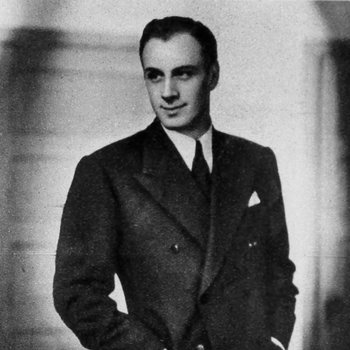
Born on January 14, 1908, and passing away on September 2, 1934, Russ Columbo was an American singer, violinist, and actor renowned for his signature song, "You Call It Madness, But I Call It Love," as well as his compositions "Prisoner of Love" and "Too Beautiful For Words." His untimely death contributed to the enduring legend surrounding his life.
Columbo hailed from Camden, New Jersey, where he was the twelfth child of Italian immigrants Nicola and Giulia (Julia) Colombo. He began playing the violin at an early age and made his professional debut at just 13 years old. By 17, he had left high school to tour with various bands across the country, performing in numerous nightclubs as both a singer and violinist.
During his career, Columbo recorded seven vocals with the band led by Arnheim as part of the string section, producing six for OKeh Records and one for Victor, titled "A Peach Of Pair," on June 18, 1930, shortly before Bing Crosby joined the group, which included Al Rinker and Harry Barris as "The Rhythm Boys."
Columbo briefly attempted to operate a nightclub, but the endeavor was unsuccessful. In 1931, he moved to New York with his manager, songwriter Con Conrad, who arranged for a late-night radio slot on NBC. This opportunity opened doors to multiple engagements, a recording contract with RCA Victor, and a growing fanbase, particularly among female listeners. Although Columbo was less enthusiastic about being categorized as a "crooner," a term popularized by him and contemporaries like Rudy Vallee and Bing Crosby, it became widely accepted, despite its initial pejorative connotation.
Columbo's songwriting contributions include "Prisoner of Love," "You Call It Madness (But I Call It Love)," co-written with Con Conrad, Gladys Du Bois, and Paul Gregory, as well as "Too Beautiful For Words," recorded by the Teddy Joyce Orchestra in 1935. Other notable works include "When You're in Love," "My Love," "Let's Pretend There's a Moon," which was recorded by Fats Waller and Tab Hunter, and "Hello Sister." "Prisoner of Love" became a standard, covered by artists such as Frank Sinatra, Jo Stafford, Art Tatum, Perry Como, the Ink Spots, Mildred Bailey, and James Brown. Perry Como scored a number one hit on the Billboard charts with his rendition, while James Brown achieved a Top 20 pop hit and performed the song on the Ed Sullivan Show and in the concert film The T.A.M.I. Show (1964).
Tragically, on September 2, 1934, Columbo was fatally shot under peculiar circumstances by his longtime friend, photographer Lansing Brown. While visiting Brown at his studio, a match struck against the wooden stock of an antique French dueling pistol ignited a long-forgotten charge, causing a lead ball to ricochet and strike Columbo in the left eye, resulting in his death almost instantly. His death was ruled accidental, and Brown was exonerated of any wrongdoing. The funeral mass attracted numerous Hollywood figures, including Bing Crosby and Carole Lombard.
In a remarkable act of familial care, Columbo's brothers and sisters withheld the news of his death from their mother for ten years, fearing it could be detrimental to her health due to her prior heart condition; she ultimately passed away in 1944. They employed various deceptive tactics, including fake letters and recordings, to create the illusion that he was still alive.
In 1958, singer Jerry Vale paid tribute to Columbo with an album titled I Remember Russ. Nearly six decades later, in 1995, singer Tiny Tim released Prisoner Of Love (A Tribute to Russ Columbo), recorded with the group Clang, honoring Columbo's legacy.
Russ Columbo rests at the Forest Lawn Memorial Park Cemetery in Glendale, California. He is also recognized as one of the historical figures mentioned in Neil Diamond's composition "Done Too Soon."