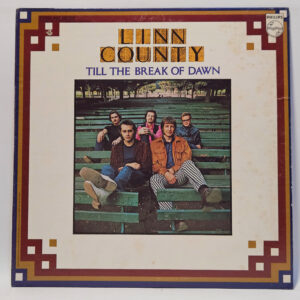
Linn County was a psychedelic rock band that originated in Cedar Rapids, Iowa, before relocating to San Francisco, California. Active from 1967 to 1970, the band emerged from the vibrant music scene fostered by local venues such as the Danceland and Armar Ballrooms. Its lineage can be traced back to earlier groups like the Bopcats, which included members Floyd (Al) Hendricks, Kenny Thompson, and Bob Schloss.
In the early to mid-1960s, Kenny Thompson formed the Prophets alongside Stephen Miller (keyboards), Ron Lustic (reeds), and Jerry (Snake) McAndrew (drums). Over time, the band's lineup evolved, with Fred Walk (guitar) and Bob Miskimen (bass) joining. Larry Easter (reeds) from Davenport, Iowa, later completed the lineup. The Prophets primarily played R&B and rock music in various clubs throughout the Midwest, including the Twilight Room and the Cougar Lounge in Cedar Rapids, and Jimmy’s Lounge in Waterloo, alongside numerous college and university performances. During this period, Miskimen departed and was replaced by Dino Long from Spencer, Iowa.
Transitioning to Chicago, the band changed its name to the Linn County Blues Band, reflecting their shared roots in Cedar Rapids. They soon became the house band at the renowned Mother Blues club on Wells Street, following in the footsteps of Spanky and Our Gang and The Paul Butterfield Blues Band, while sharing the stage with notable artists such as Muddy Waters, Buddy Guy, Junior Wells, Howling Wolf, and James Cotton. John Cabalka, a friend from Cedar Rapids working for Mercury Records, took on the role of manager, with Ed Adkins from Cedar Rapids serving as road manager.
The band signed with Dunwich Records and began recording an LP at Chess Studios when Mercury Records acquired their contract and subsequently signed them. Mercury requested that the band shorten their name to Linn County to avoid being pigeonholed as a blues band. The label then relocated the band from Chicago to San Francisco for living and recording purposes. Following this move, Jerry McAndrew left the band, and Clark Pierson was brought in as a replacement.
Linn County was notable for being the only Iowa-rooted band to perform at prominent venues such as The Avalon Ballroom, Fillmore West, The Matrix in San Francisco, The Bank in Los Angeles, Thee Experience in Hollywood, Fillmore East and The Scene in New York City, and The Grande Ballroom in Detroit, among other locations in Montreal, Cleveland, Chicago, Sacramento, and Pittsburgh. The band also secured the highest-paying recording contract for any group from Iowa, receiving approximately $50,000 to sign with Mercury Records—a substantial amount in the mid-1960s when many bands had to pay to record.
After releasing three albums in the Bay Area and Los Angeles, along with a solo album by Stephen Miller and extensive touring in the early 1970s, Miller left to tour and record with Elvin Bishop. Clark Pierson went on to play with Janis Joplin, while the remaining members explored various personnel combinations and continued to perform around California until the band's brief dissolution in the early 1970s.
In 1974, Stephen Miller relocated to Lisbon, Iowa, where he reformed Linn County with new members Ron Dewitte (guitar), Perry Welsh (mouth harp), Johnny (Ace) Acerno (bass), and Joe Eberline on drums (later replaced by Walter Salwitz). Tom Krejci, an entrepreneur from Cedar Rapids, took on management responsibilities. Eventually, Stephen left to tour and record with Grinderswitch on Capricorn Records, leading to the addition of Tommy Giblin (organ). This iteration of Linn County achieved considerable success and popularity, particularly in the Cedar Rapids-Iowa City area and major Midwestern cities. The band ultimately disbanded in 1977, but many of its members continued to play, write, and record with various groups. Linn County remains a distinctive band that left a lasting impact on musicians and fans across the United States and Canada during the mid-1960s to mid-1970s.