Charles Louis Brown
Born: August 22, 1936, Gaston, North Carolina
Died: May 16, 2012, Johns Hopkins University Hospital, Baltimore, Maryland, after being hospitalized for pneumonia earlier that month. He was 75 years old.
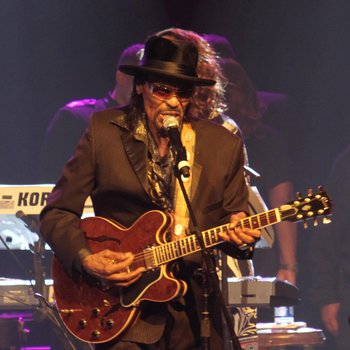
Revered as the "Godfather of Go-Go," Chuck Brown was a versatile performer, singer, guitarist, and songwriter who crafted his distinctive brand of funk in the mid-1970s as a response to the prevailing disco scene.
Employing a technique reminiscent of a DJ mixing records, Brown utilized continuous percussion to seamlessly weave songs together, ensuring that audiences remained engaged on the dance floor during his extended performances that often lasted well into the night. He explained that the genre was named "go-go" because “the music just goes and goes.” As go-go evolved into a symbol of pride for black Washingtonians, Brown emerged as one of the city’s most prominent figures. In recognition of his contributions, a portion of Seventh Street NW was renamed "Chuck Brown Way" in 2009, located near the Howard Theatre, where he once shined shoes as a child. His charismatic personality made him a beloved figure, often appearing in advertisements for the D.C. Lottery and The Washington Post, and he became known as the city’s unofficial mascot, frequently flashing his gold-toothed smile for fans eager to take photos with him. His presence outside Ben's Chili Bowl on U Street NW could halt traffic.
At the age of eight, Brown moved with his family to Washington, D.C., where he left school to pursue various odd jobs. He sold newspapers at the bus station and polished shoes at the Navy Yard, where he received generous tips from entertainers such as Hank Williams and Les Paul.
During his teenage years, Brown encountered difficulties, including a brush with petty crime that culminated in a significant incident in the mid-1950s when he shot a man in what he claimed was self-defense. He was convicted of aggravated assault, which escalated to a murder charge following the victim's death six months later. Brown served eight years at the Lorton Correctional Complex, where he traded five cartons of cigarettes for a guitar from another inmate.
Upon his release, Brown returned to Washington, taking on jobs as a truck driver, bricklayer, and sparring partner in local boxing gyms. He began playing guitar and singing at backyard barbecues, although his parole officer prohibited him from performing in liquor-serving nightclubs.
In 1964, Brown joined Jerry Butler and the Earls of Rhythm, followed by a stint in 1965 with a group called Los Latinos, both of which played top-40 hits in local nightclubs. In 1966, he formed his own band, the Soul Searchers, which achieved minor hits in the early 1970s with songs like "We The People" and "Blow Your Whistle."
Brown's go-go music was heavily influenced by jazz and pop standards; elements from jazz classics such as "Moody’s Mood for Love" and "Harlem Nocturne" found their way into his "Go-Go Swing," while he transformed Louis Jordan’s calypso "Run Joe" into a go-go staple. This genre also left its mark on jazz—most notably when trumpeter Miles Davis incorporated longtime Soul Searchers drummer Ricky Wellman into one of his final touring bands, and elements of go-go rhythms appeared on Davis’s 1989 album "Amandla."
Although hip-hop began to overshadow go-go in the 1980s, Brown's influence extended into that realm as well, with several hip-hop artists sampling his work, including Nelly in his 2002 hit "Hot in Herre."
Brown’s impact was particularly felt in the Washington area, where his sound inspired a new generation of bands, and he remained a staunch advocate for the genre. Reflecting on his career in 2001, he stated that “Bustin’ Loose” was the one record he had immense confidence in, mentioning that he spent two years refining it, ultimately using just two lines of lyrics. This single became his most successful track, while throughout the 1980s, songs like "We Need Some Money," "Go-Go Swing," and "Run Joe" emerged as local anthems, bolstered by radio play and Brown’s rigorous performance schedule, which often saw him on stage six nights a week.
In his later years, while performing less frequently, Brown continued to take the stage, asserting in 2006, “I’m not retired because I’m not tired. I’m still getting hired and I’m still inspired. As long as I can walk up on that stage, I want to make people happy. I want to make people dance.”
Formal recognition of Brown’s contributions came later in his life; in 2005, he received a Lifetime Heritage Fellowship Award from the National Endowment for the Arts. He earned his first Grammy nomination in 2011 at the age of 74 for Best Rhythm-and-Blues Performance by a Duo or Group with Vocals for "Love," a collaboration with singer Jill Scott and bassist Marcus Miller.