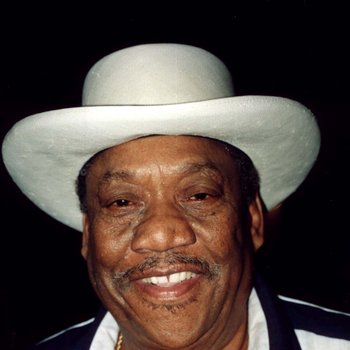
American blues and R&B singer, known for his powerful vocal style, was born on January 27, 1930, in Rosemark, Tennessee, and passed away on June 23, 2013, in Germantown, Tennessee. He was often referred to as the "Lion of the Blues" and the "Sinatra of the Blues."
In 1947, he relocated to Memphis with his mother, where he began singing with various local gospel groups, including The Miniatures. His desire to explore new musical avenues led him to the renowned Beale Street, where he connected with a group of emerging musicians who called themselves the Beale Streeters, which included notable artists such as B.B. King, Rosco Gordon, Little Junior Parker, and Johnny Ace. Between 1950 and 1952, he attempted to launch his recording career with several singles for Modern Records (2) and, at the encouragement of Ike Turner, for Sun Record Company, which licensed his recordings to the Chess label. Eventually, he signed with Duke Records. Upon returning to Memphis in 1954, he found several former associates, including Johnny Ace, enjoying significant success, prompting him to join Ace's revue.
Bland returned to Duke Records, which had started to be managed by Houston entrepreneur Don Robey. He released his first single for the label in 1955. In 1956, Bland began touring the "chitlin' circuit" with Junior Parker in a revue called Blues Consolidated, where he also served as Parker's valet and driver, along with similar duties for B.B. King and Rosco Gordon. During this period, he began recording for Duke with bandleader Bill Harvey and arranger Joseph Scott (2), developing the distinctive vocal style that would define his career and collaborating with Harvey and Scott to create the melodic big band blues singles for which he became renowned, often accompanied by guitarist Wayne Bennett (2).
His breakthrough on the charts came in 1957 with the R&B number one hit "Farther Up The Road," which also reached number 43 on the Billboard Hot 100. This success was followed by a series of R&B hits, including "Little Boy Blue" in 1958. Bland also shared an album with Parker titled Blues Consolidated that same year. His artistry was particularly evident in his early 1960s releases, such as "Cry Cry Cry," "I Pity The Fool" (which topped the R&B chart in 1961), and "Turn On Your Love Light," a song that became a widely covered standard. While some credits often attributed his works to Robey, many classic compositions were actually written by Joseph Scott. Bland's final number one on the R&B chart came with "That's The Way Love Is" in 1963, although he continued to achieve consistent R&B chart entries throughout the mid-1960s. Despite not fully penetrating the mainstream market, his highest position on the pop chart was number 20 with "Ain't Nothing You Can Do" in 1964. He secured 23 Top Ten hits on the Billboard R&B charts and was ranked the 13th all-time R&B charting artist by Joel Whitburn in the 1996 book Top R&B Singles 1942-1995.
Financial difficulties led to the dissolution of his touring band in 1968, coinciding with the sale of Duke Records by Don Robey to a larger group. This transition allowed Bland to produce several successful and critically acclaimed contemporary blues and soul albums, including His California Album (1973) and Dreamer (1974). The lead single from the former, "This Time I'm Gone For Good," marked his return to the pop Top 50 for the first time since 1964 and climbed into the R&B top 10 in late 1973. In 1985, he signed with Malaco Records, a label known for traditional Southern black music, and continued to release albums while touring with fellow blues artist B.B. King.
Bland was inducted into the Blues Hall of Fame in 1981 and the Rock and Roll Hall of Fame in 1992, and he received the Grammy Lifetime Achievement Award in 1997. He continued to perform until shortly before his death, which occurred on June 23, 2013, at his home in Germantown, Tennessee, following what family members described as "an ongoing illness."