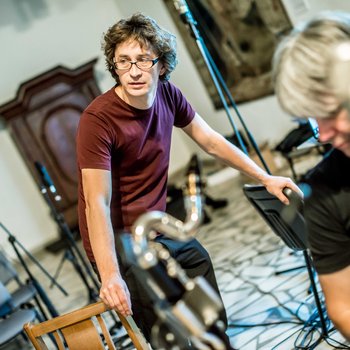
Vykintas Baltakas, born in 1972, began his musical journey at the Lithuanian Music Academy from 1990 to 1993, where he studied composition under Vytautas Barkauskas and conducting with Lionginas Abarius. During this time, he founded and directed the vocal ensemble "Penki vėjai" and the chamber choir "Aidija." From 1993 to 1997, he continued his education at the Hochschule für Musik Karlsruhe, studying composition with Wolfgang Rihm and conducting with Andreas Weiss. He participated in the Darmstadt summer courses from 1994 to 1996, where he was recognized with an award for his solo piano piece, Pasaka (Fairy Tale), in 1996. In 1997, he attended composition courses led by Emmanuel Nunes at the Paris Conservatoire. Between 1994 and 1997, Baltakas studied under composer Peter Eötvös and served as Eötvös' assistant at the Karlsruhe Music Academy starting in 1995. From 1999 to 2000, he worked at IRCAM in Paris and received composer grants from the Heinrich Strobel Foundation, Herrenhaus Edenkoben, and the Nadia and Lili Boulanger Foundation.
In 2001, a portrait concert featuring Vykintas Baltakas' compositions was held at the Gasteig in Munich. The following year, the Kölner Philharmonie, under the baton of Sylvain Cambreling, premiered his orchestral work Poussla. In 2003, he was awarded the Claudio Abbado International Prize for composition, and that same year, his music was performed at notable concerts in London, Berlin (MaerzMusik), Strasbourg (Ars Musica), and Paris. The world premiere of his composition about to drink dense clouds, commissioned by Wiener Festwochen and Klangforum Wien, took place in Vienna, conducted by the composer himself. In 2007, he received the Siemens Foundation Prize.
The world premiere of his chamber opera Cantio occurred on May 18, 2004, at the Münchener Biennale and was later presented to Lithuanian audiences at the Gaida festival, where it was honored as the Best Lithuanian Musical Composition of the year in the stage works category. Vykintas Baltakas' compositions are published by Universal Edition in Vienna and Aust Musik Verlag in Cologne.
As a conductor, Baltakas has collaborated with ensembles such as the Symphonieorchester des Bayerischen Rundfunks (BR), Rundfunk-Sinfonieorchester Berlin, WDR-Sinfonieorchester Köln, Deutsches Symphonie-Orchester Berlin, and Klangforum Wien, among others. In 2003, he conducted the premiere of Karlheinz Stockhausen's new work for orchestra and choir, Hoch-zeiten, at the Cologne Philharmonic Society with the WDR-Sinfonieorchester Köln.
His compositions are noted for their meticulous research and intentional manipulation of musical material. Rather than adhering to established stylistic conventions, Baltakas develops unique musical criteria for each piece. Although his relatively small body of work features elements of theater, wit, and irony, it remains tightly structured, reflecting his self-critical approach. The inspirations for his compositions range from specific or metaphorical images to lyrical poetry, formal models, or energy patterns. In his orchestral piece "Pusline," premiered in 2002, Baltakas envisioned an ever-evolving energy field that offers new listening experiences.
Often revising his pieces after their premieres, Baltakas' oeuvre resembles a continuous, large-scale work in progress. Despite its straightforward design, his music frequently reveals a sensitive and, at times, intuitive character. He has remarked, "Some of my pieces have such delicate sound that they find themselves on the border between sound and non-sound, being and non-being. Therefore, a certain impetus is required to maintain this sound. I have an image of a feather floating in the air, kept aloft by light puffs of wind."