George Barnes, an American swing jazz guitarist, was born on July 17, 1921, in South Chicago Heights, Illinois, and passed away on September 5, 1977, in Concord, California. He began his professional journey at the young age of 12, when he obtained his musicians' union card and began touring the Midwest. By the time he reached 14, Barnes was already accompanying notable blues vocalists like Big Bill Broonzy and Blind John Davis. On March 1, 1938, he recorded "Sweetheart Land" and "It's a Lowdown Dirty Shame" with Broonzy, marking the first commercial recordings featuring an electric guitar. Later that same year, he joined the NBC orchestra as a staff musician, becoming a prominent performer on radio shows such as National Barn Dance and Plantation Party.
In 1940, Barnes made his debut recording under his own name with Okeh Records, releasing "I'm Forever Blowing Bubbles" alongside "I Can't Believe That You're In Love With Me." After being drafted into the Army in 1942, he returned to civilian life in 1946 and established The George Barnes Octet. He married Evelyn Lorraine Triplett in Chicago on January 17, 1947.
In 1951, Barnes signed with Decca Records through Milt Gabler and relocated to New York City. Two years later, he joined the orchestra for the television program Your Hit Parade, where he was featured as a soloist under the direction of Raymond Scott. Alongside Scott and vocalist Dorothy Collins, who was Scott's wife, Barnes also recorded various performances.
Beyond his reputation as a jazz musician, Barnes worked extensively as a studio musician, contributing to hundreds of albums and jingles from the early 1950s through the late 1960s. While he specialized in swing jazz, he displayed versatility across genres, including pop, rock, and R&B. He was a regular guitarist on many of The Coasters' hits produced by Jerry Leiber and Mike Stoller, played the guitar solo on Connie Francis's "Lipstick on Your Collar," and featured on The Drifters' rendition of "This Magic Moment" and Jackie Wilson's "Lonely Teardrops."
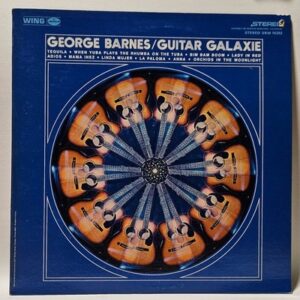
Barnes recorded three albums for Mercury Records, with the latter two showcasing his distinctive orchestrations featuring ten guitars, known as his "guitar choir," which utilized guitars in a manner akin to a horn section. His collaborations with guitar duo partner Carl Kress garnered national acclaim in the early 1960s. Following Kress's passing in 1965, Barnes teamed up with Bucky Pizzarelli, a partnership that lasted from 1969 to 1972, resulting in two recorded albums. In 1973, he formed a collaboration with cornetist Ruby Braff.
From 1973 until his death in 1977, Barnes recorded several well-received albums for Concord Jazz, both as a solo artist and with the quartet he formed with Braff. After his final European tour in 1975, he and his wife, Evelyn, relocated from New York City to the San Francisco Bay Area. Barnes died of a heart attack in Concord, California, at the age of 56.
His musical style developed prior to the advent of bebop, and he maintained a swing aesthetic throughout his career. His guitar lines were typically short, melodic, bluesy, and diatonic, contrasting with the chromaticism of bebop guitarists. His improvisations often included call-and-response phrases, and his tone was noted for its clarity and brightness, reflecting his upbeat approach to music.
In the final years of his life, Barnes recorded three live albums, two from a concert at Bimbo's 365 in San Francisco and another at The Willows Theatre in Concord. These recordings exemplified his swinging, joyful style and included his humorous exchanges with the audience, showcasing his personality.
In 1942, Barnes authored The George Barnes Electric Guitar Method, the first electric guitar instructional book, published by Wm. J. Smith. He later penned George Barnes' Living Guitar Method in 1961 for Music Minus One, as well as Ten Duets for Two Guitars, recorded with Kress. His 1965 publication, How to Arrange for Solo Guitar, was released by Peermusic. Additionally, he produced the first guitar course available on cassette tape, The Great George Barnes Guitar Course, published in 1970 by Prentice Hall.